07 February, 2015

Day Four - Joshua's Life Motto


I've been reading through the Bible, and at present, I just finished the book of Joshua. There seemed to be a recurrent theme throughout it... Can you guess what it was?

“Be strong and of a good courage; be not afraid, neither be thou dismayed: for the Lord thy God is with thee withersoever thou goest.” (Joshua 1:9)

These words, or variations of them, are mentioned seven times in the short book of Joshua. The first three times, it is God speaking to Joshua. Next, Joshua tells the people. Then the Lord again speaks it to Joshua, after they lost the battle of Ai. Once more God tells Joshua to fear not, in the battle with the five kings of the Amorites. Finally, Joshua repeats it to the congregation, when he is making his final speech, before he dies.

Three times also, when Moses was appointing Joshua to continue the work of leading the children of Israel, back in Deuteronomy, Moses 'charged' Joshua, saying “Be strong and of a good courage, fear not, nor be afraid of them: for the Lord thy God, he it is that doth go with thee; he will not fail thee, nor forsake thee.”

These words shaped Joshua's life: God gave them in the beginning, through Moses, God repeated them after Moses died and throughout Joshua's life, particularly during hard battles, until when Joshua himself was 'old and stricken in age' he passed them on to the people. It was like his legacy.

All this made me think, what is my life motto? What is something I live by, that I value so much I would want to pass it on to those coming after me? I can't say there is anything, but it made me think of a powerful quote by Martin Luther, that I found a couple of weeks ago: “God created the world out of nothing, and as long as we are nothing, He can make some thing out of us.”

That's what I want my life motto to be, in two senses. The first just what we've been talking about; I want those to be the words that I live by. Just imagine the possibilities there is for God to use us, if we're not full of ourselves! The second sense though, I want that to the theme people see when they look at my life. I want it to be obvious that I am nothing, and God is everything. It's like one of those equations in maths. "Solve for x: Nothing + x = Humans, us. X equals God." He's the only reason we're actually here, “for in him we live, and move, and have our being” (Acts 17:28).

Anyway, thanks for reading my ramblings... What are your thoughts on 'life mottos'? 

Jessica xxx :)

06 February, 2015

Day Three - Have a Cup of Tea?


(Man, somehow these titles end up rhyming. It's not purposely, I assure you.)


I made these little apple and date tart things a few weeks ago. They did end up tasting quite good, but to be honest, the reason I made them was so that I had something to take photos of. :) I'm into taking photos of food these days – it's lots of fun. And rather challenging: you're not going to see my first attempts. :P

Anyway, here's three of my current favourites:

1. This quote:

“There is so much good in the worst of us,

And so much bad in the best of us,

That it hardly behoves any of us,

To talk about the rest of us.”

Edward Wallis Hoch


2. This Bible passage:

Is not this the fast that I have chosen? to loose the bands of wickedness, to undo the heavy burdens, and to let the oppressed go free, and that ye break every yoke? Is it not to deal thy bread to the hungry, and that thou bring the poor that are cast out to thy house? when thou seest the naked, that thou cover him; and that thou hide not thyself from thine own flesh? Then shall thy light break forth as the morning, and thine health shall spring forth speedily: and thy righteousness shall go before thee; the glory of the LORD shall be thy rereward. Then shalt thou call, and the LORD shall answer; thou shalt cry, and he shall say, Here I am. If thou take away from the midst of thee the yoke, the putting forth of the finger, and speaking vanity; and if thou draw out thy soul to the hungry, and satisfy the afflicted soul; then shall thy light rise in obscurity, and thy darkness be as the noonday: and the LORD shall guide thee continually, and satisfy thy soul in drought, and make fat thy bones: and thou shalt be like a watered garden, and like a spring of water, whose waters fail not. And they that shall be of thee shall build the old waste places: thou shalt raise up the foundations of many generations; and thou shalt be called, The repairer of the breach, The restorer of paths to dwell in.
Isaiah 58:6-12


3. This word: erxcellent, or is it urxcellent. I'm pretty sure I made it up, but I like it. :) It just means the same as excellent, by the way, if you want to add it to your vocabulary.

So, what are your favourites of late? Am I the only one who has 'current favourite words'?

See you again tomorrow! (Three down, four to go!:)

Jessica xxx :)

05 February, 2015

Day Two - One Thousand Gifts - Book Review


If you've been talking to me in the last few weeks, you'll already know that I've been reading One Thousand Gifts, and enjoying it. But here's the thing: I never meant to like this book. I mean, I read the first few pages of it almost four years ago, and I didn't get it. I found it hard to read, wordy and not riveting in the slightest. So I put it down. But since then, it seems to have popped up everywhere; in book catalogues and shops, and on the internet. It looked good. Every time, however, I dismissed the thought of reading it, because after all, I had tried before. But more and more, I noticed people on the internet saying good things about the book, and creating lists of gifts, and speaking so highly of the whole idea. So I succumbed. I borrowed the book, and read it. And now I see what everybody was talking about.

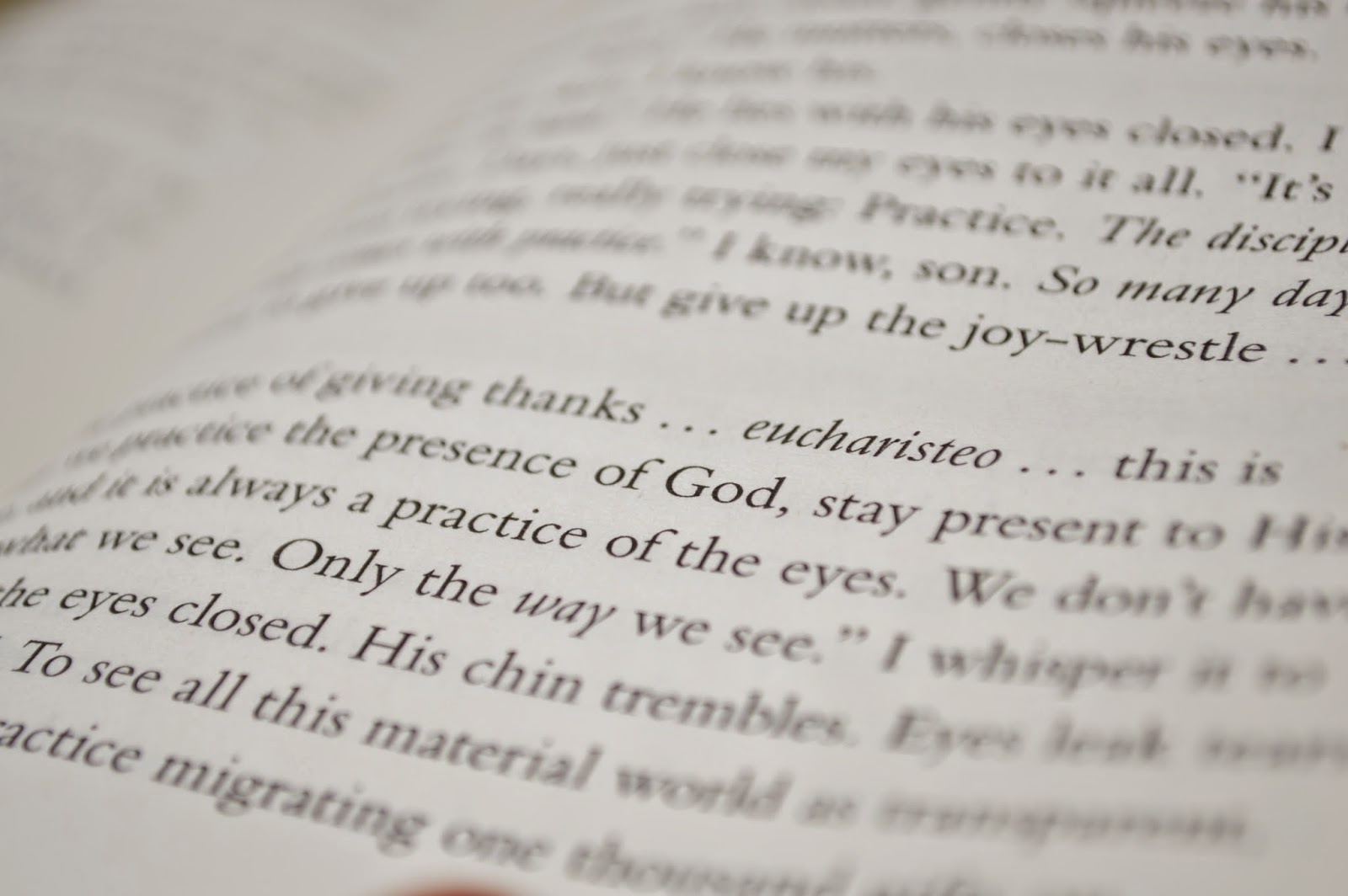
One Thousand Gifts, in short, is amazing. After reading the first few chapters, I thought I knew what Ann Voskamp was on about; yes, we must give thanks, count our blessings. I had heard of that before. But then, she somehow linked all these things – joy, grace, faith, trust, humility, anxiety – to this central word, eucharisto: the giving of thanks.

It started to make sense when she said, “Satan's sin becomes the first sin of all humanity: the sin of ingratitude.” (OTG p15) He wasn't thankful for all the privileges he had already been given: he wanted more. He wanted to be like the Most High. Then, Adam and Eve came to the same fate. They weren't grateful for all that God had already given them; they wanted knowledge of good and evil. She goes on: “If our fall was the non-eucharisto, the ingratitude, then salvation must be intimately related to eucharisto, the giving of thanks.” (OTG p39) Wow. Not because the work of giving thanks saves us, but because it brings us into a deeper relationship with God. He gives us gifts, we thank him for them, He gives us more – the cycle continues. Ann likens the relationship to that of a bride and bridegroom – which is exactly what we are: the church is the bride of Christ.

There were so many quotable lines in this book, I felt like I was continually writing them down. Yes, if you had asked me before why I hadn't read this book, I would've said, “The writing style: It's modern, and not flowing, full of incomplete thoughts, and one-sentence paragraphs. And it's wordy, and a bit too sort of deeply thought.” Now? Well, yes, the writing style is different - some call it poetic. But after the first couple of chapters, I sort of got used to it, and it was fine. I actually really liked the way Ann used everyday stories from her life to bring out the things God had been teaching her – to find beauty and grace in the little things. It gave me courage, because my stories are little, and everyday and ordinary. Yet, if God could use Ann's mounds of washing, trips to town, and children's arguments to speak to and teach her, I expect He can do the same for us.

One Thousand Gifts has really inspired me. It's inspired me to live a life of eucharisto. It's also made a lot of things simpler too. And questions I've thought about, such as: How do I get more faith? How do I be more be humble? How can I really believe? What about hard times? How can I be truly happy? They are all covered, and so simply and logically linked to being thankful: eucharisto. I couldn't believe it; everything made so plain. And now, of course, I've begun counting gifts. I did actually do that spasmodically in the past, but they were very general: family, friends, good day shopping, etc. That's all still true, but I'm trying to be more specific, and look for the tiny gifts in each moment.

So why didn't I like it before? I think I was too young. I used to read books just to read books, and read as many of them as possible. Now, I still do the same thing (:D), but I try to learn from the books I read, and read them slowly, if necessary, to really take it in. And this one takes thinking about; it's deep. It's the kind of book, that when reading you have to come up for air sometimes. Because it's just that profound; I had a lot of 'Ah!' moments while reading it. I couldn't race through it (yes, that would be why I couldn't read it years ago), I felt like I needed to give each thought time to digest. And I know I've forgotten a lot already. I think it's the kind of book to reread every few months or year. I might have to buy myself a copy now.

Anyway, I know this review has not done this book justice in the slightest; there's so much more in it. I couldn't recommend it enough; I'm sure everybody can get something out of it. You really have to read it for yourself, to experience it, and be inspired to begin your own life of eucharisto. 

But thanks for reading, and I'm really eager to hear if you've read One Thousand Gifts before. Or is it on your to-read list now? ;)

Jessica xxx :)